6 min read

Bullet Delivery Is Fast. But in a City Like Riyadh, Fast Alone Isn't Enough.

Bullet Delivery Is Fast. But in a City Like Riyadh, Fast Alone Isn't Enough.

Speed is the most visible dimension of delivery. It's what gets marketed, what customers notice, and what merchants use to differentiate. Bullet delivery — point-to-point dispatch where a driver picks up directly from your location and drops off at the customer's door — is the most direct expression of that speed.

In the right conditions, it works extremely well. A single pickup point, a nearby customer, low traffic, accurate address. Clean execution.

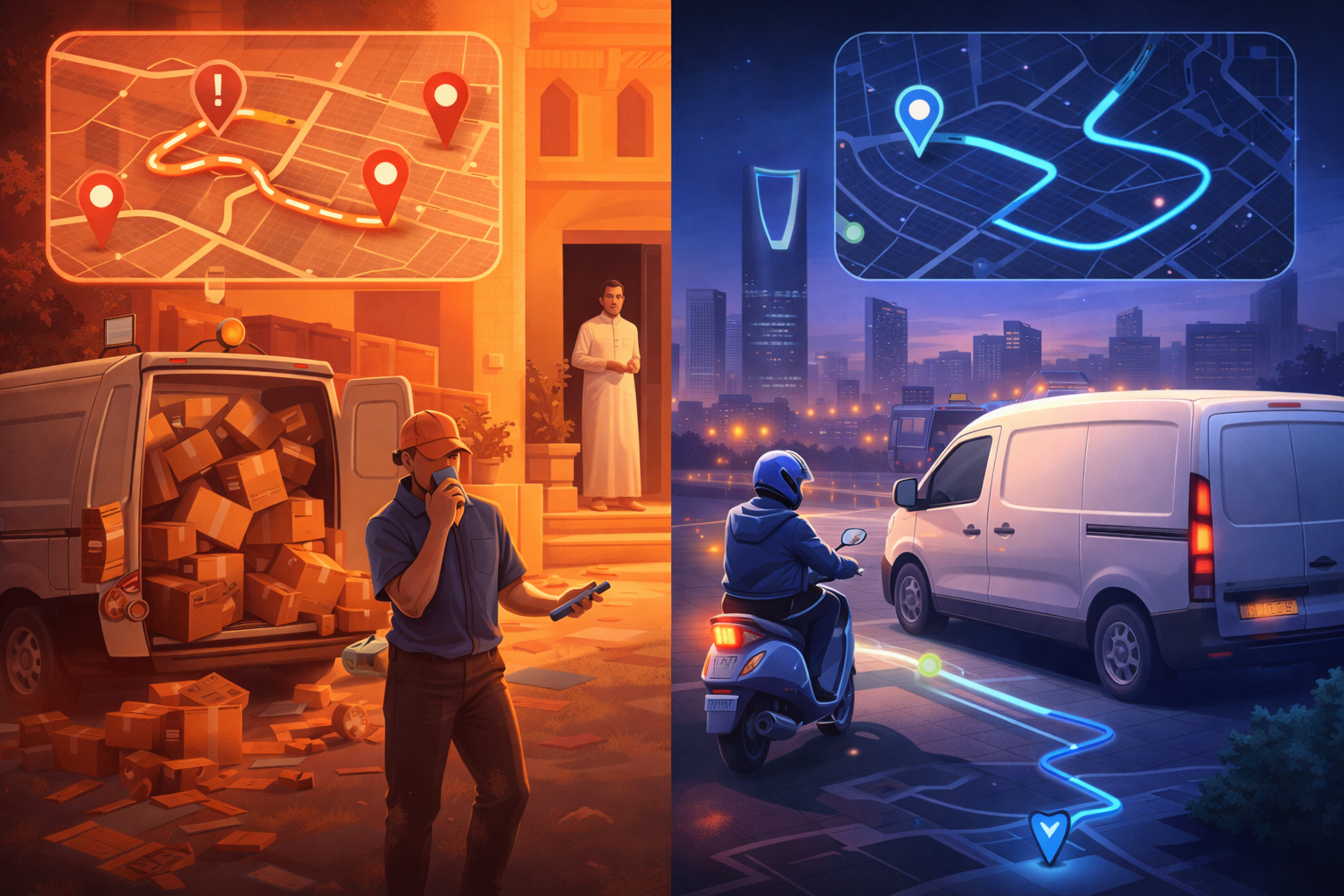
But Riyadh is not a controlled environment. It is a rapidly expanding city of over seven million people, with complex traffic patterns, dispersed residential clusters, inconsistent address data, and delivery demand that spikes unpredictably across the day. In this environment, bullet delivery exposes a set of structural limitations that compound at scale — and that every growing e-commerce merchant will eventually collide with.

This post breaks down exactly what those limitations are, why they matter to your unit economics, and how integrating a dark store network resolves them without sacrificing the speed that makes delivery competitive in the first place.


PART ONE

The real drawbacks of bullet delivery in a large city

Bullet delivery is not broken. But it is optimized for a set of conditions that large cities systematically violate. Understanding where the model struggles is the first step to building a delivery strategy that holds up at scale.

1. Distance variability destroys delivery time consistency

In bullet delivery, every order originates from a fixed point — your warehouse or store. The distance to each customer is determined entirely by where that customer happens to live. In a city the size of Riyadh, that variance is enormous.

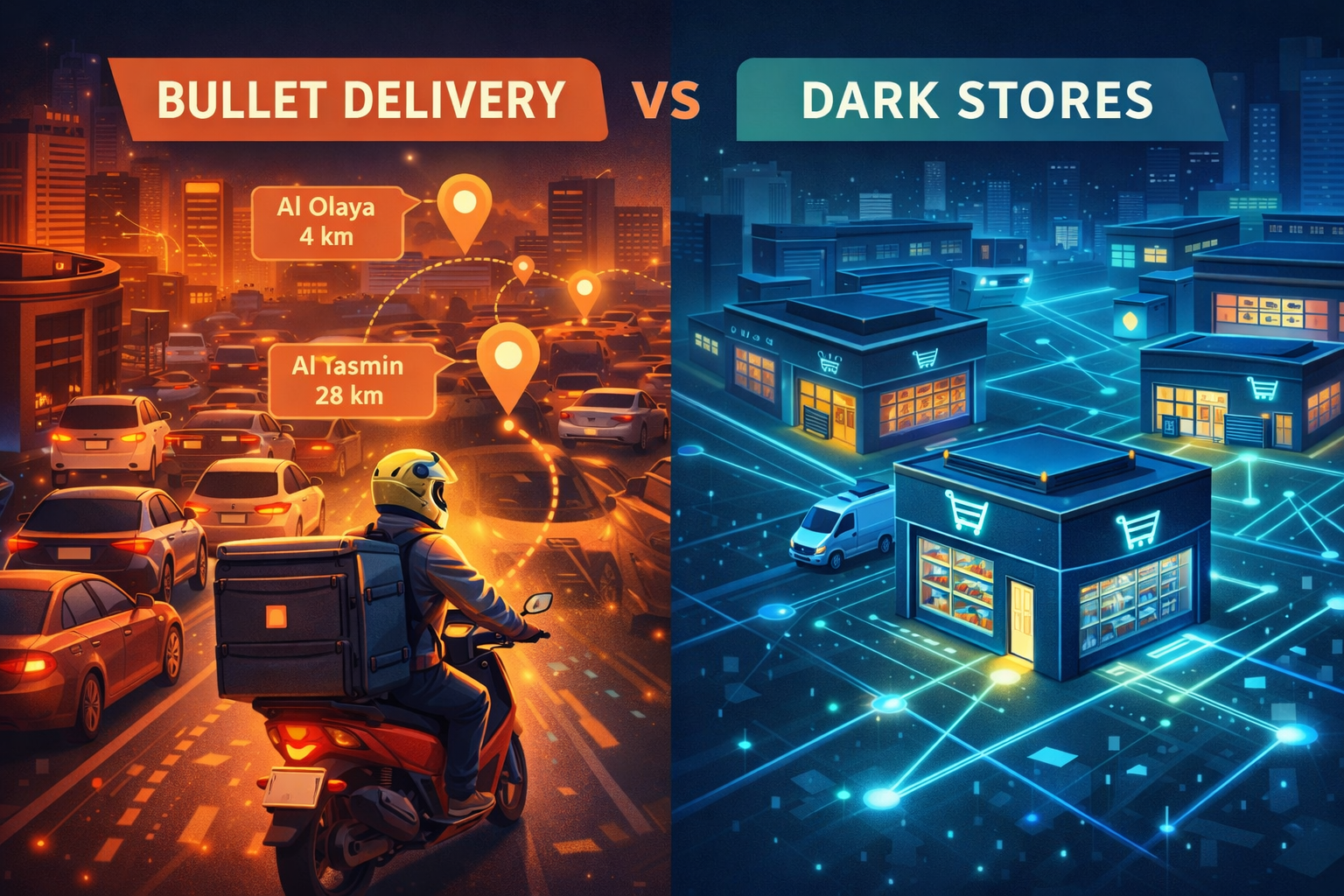
A customer in Al Olaya might be 4 kilometers from your dispatch point. A customer in Al Yasmin might be 28 kilometers away. Both place the same order, both expect a similar experience. But the driver dispatched to Al Yasmin is not just traveling further — they're traveling through different traffic conditions, encountering different address complexity, and spending significantly more time per delivery.

The result is an SLA you cannot consistently honor without either overpromising to nearby customers or underpromising to far ones. Neither is a good commercial outcome.

3.2x average delivery time variance between nearest and furthest customer zones in Riyadh from a central dispatch point

41% of customer complaints about delivery in Saudi Arabia relate specifically to inconsistent ETAs rather than absolute delivery time


2. Traffic congestion creates unpredictable cost spikes

Riyadh's road network is extensive but its traffic patterns are volatile. Peak hours — morning commute, post-Asr, and post-Maghrib windows — create congestion that significantly extends delivery times on routes that are fast at other hours.

For bullet delivery, this creates a direct cost problem. Drivers spend more time per delivery, reducing the number of deliveries completed per shift. Fuel consumption rises. Customer-facing ETAs become unreliable. And if you're absorbing delivery cost as part of a free shipping offer, your per-order cost rises without any corresponding increase in order value.

This isn't an operations problem you can solve by hiring more drivers. It's a geometry problem — your orders and your customers are distributed across a city whose infrastructure creates time-of-day delivery costs that vary by a factor of two or more.

"Adding drivers doesn't fix a traffic problem. It just means more drivers sitting in the same traffic. The solution is to reduce the distance, not increase the headcount."

3. Address complexity multiplies at scale

Saudi Arabia's National Address system has significantly improved address standardization, but field-level accuracy — especially in older residential districts and newer developments — remains inconsistent. Drivers routinely encounter addresses that are technically valid but practically ambiguous: buildings without visible numbers, streets with duplicate names across districts, PIN drops that land 200 meters from the actual entrance.

In bullet delivery from a central point, every driver covering the whole city encounters this complexity across every neighborhood they serve. Resolution time — the minutes a driver spends calling the customer, navigating to a corrected location, or waiting at a wrong address — adds directly to your per-delivery cost and degrades the customer's experience at the most critical moment.

1 in 3 deliveries in Riyadh requires at least one driver-customer phone call to resolve address ambiguity

6–11 min average resolution time per address issue — time billed against your delivery SLA


4. Scaling order volume compounds all of the above

Each of the limitations above is manageable at low order volumes. A merchant fulfilling 20 orders a day can absorb inconsistent ETAs, occasional traffic delays, and address friction. The economics are forgiving when the base is small.

But bullet delivery's cost structure does not improve meaningfully as you scale. Distance variance, traffic exposure, and address complexity don't diminish as volume grows — they multiply. More drivers cover more of the city more of the time, which means more exposure to every variable that makes delivery expensive and inconsistent.

This is the ceiling that merchants hit when they try to grow on a pure bullet delivery model. The unit economics that were acceptable at SAR 15,000 monthly GMV become unsustainable at SAR 150,000.


PART TWO

How dark stores complement bullet delivery

The solution is not to abandon bullet delivery. Point-to-point speed remains genuinely valuable and should remain part of a merchant's logistics toolkit. The solution is to use dark stores to remove the structural constraints that prevent bullet delivery from performing consistently in a large city.

Here is how the two models work together:

Solving distance variability: inventory moves closer to the customer

A dark store network distributes fulfillment nodes across the city's residential clusters. Instead of every order originating from a single central point, orders are routed to the nearest dark store that holds the required inventory.

The effect on distance variability is immediate and dramatic. Where a central dispatch point might serve customers at distances ranging from 3 to 35 kilometers, a neighborhood dark store serving a defined 3 to 5 kilometer radius eliminates that variance almost entirely. Every customer within that zone is effectively the same distance from the fulfillment point.

Bullet delivery from a dark store is not slower than bullet delivery from a central warehouse. It is faster — and consistently so — because the origin point is already inside the customer's neighborhood.

3–5 km typical service radius of a DAZZ dark store node in Riyadh

28 min average delivery time from dark store dispatch vs. 2.4 hours from central warehouse


Solving traffic exposure: shorter routes mean less congestion impact

Traffic congestion affects every route in Riyadh, but its impact on delivery time is proportional to route length. A driver traveling 4 kilometers through a congested district loses 8 to 12 minutes to traffic. A driver traveling 28 kilometers loses 45 to 60 minutes on the same day.

Dark stores reduce route length by design. A delivery originating from a neighborhood node and terminating within that same neighborhood is almost entirely insulated from the major arterial congestion that punishes long cross-city routes. Peak hour traffic becomes a marginal cost rather than a structural one.

This has a direct impact on your delivery cost per order. Shorter routes mean higher driver productivity — more deliveries per shift, lower fuel cost per delivery, and more reliable ETAs that don't require heavy traffic buffers.

Solving address complexity: neighborhood knowledge replaces city-wide guesswork

A driver who operates within a defined 3 to 5 kilometer radius builds detailed local knowledge of that area over time. They learn which buildings have unmarked entrances, which PIN drops are consistently inaccurate, and which streets have local naming conventions that differ from the official address.

This is not a trivial operational advantage. Local knowledge reduces the frequency of address resolution calls, shortens the time spent resolving the ones that do occur, and produces a measurably better customer experience at the doorstep — the moment that determines whether a customer leaves a five-star review or a complaint.

Centralized bullet delivery cannot replicate this. A driver covering all of Riyadh cannot build neighborhood-level familiarity across hundreds of distinct residential areas. The dark store model makes local expertise a structural output of how the network is designed, not a function of individual driver tenure.

Solving the scale problem: unit economics that improve with volume

This is where the combined model creates its most significant commercial advantage. Dark store operations achieve better unit economics at higher volumes — fixed facility costs are spread across more orders, inventory positioning improves as demand data accumulates, and driver productivity increases as route density within each zone grows.

This is the inverse of the bullet delivery scaling problem. Rather than compounding costs as volume grows, the dark store model produces compressing costs — lower cost per delivery, faster fulfillment, and more reliable service quality as order density increases.

For a merchant targeting growth, this distinction matters enormously. The logistics infrastructure you build for your first SAR 50,000 in monthly GMV should be the same infrastructure that serves you at SAR 500,000 — with better economics, not worse.

 
"The dark store model doesn't replace the speed of bullet delivery. It removes the city-scale constraints that prevent bullet delivery from being consistent, affordable, and scalable."


What this looks like in practice for your store

Practically, a merchant integrating with a dark store-backed bullet delivery model makes three operational changes:

  1. Inventory is pre-positioned at dark store nodes based on your order data and demand forecasting — high-velocity SKUs closest to your densest customer clusters.
  2. Orders are automatically routed to the nearest dark store with available stock at the moment of purchase, rather than dispatched from a central point.
  3. Drivers are dispatched from inside the customer's neighborhood, covering short routes within a defined zone rather than cross-city distances.


The customer experience is: they choose a delivery window at checkout, their order is picked and packed at the local node in minutes, and a driver completes the final 3 to 5 kilometer leg on schedule. The ETA you communicate at checkout is the ETA that is honored.

For you as a merchant, the outcome is: lower cost per delivery as volume scales, a first-attempt success rate that materially reduces return-to-origin fees, and a post-purchase experience that builds the kind of trust that drives repeat purchase — the single highest-ROI outcome in e-commerce.


Quick reference: bullet delivery vs. dark store-backed delivery

Distance per delivery: 3 to 35 km (central)

Distance per delivery: 3 to 5 km (dark store)

Traffic exposure: High on cross-city routes

Traffic exposure: Minimal — neighborhood routes only

Address resolution: City-wide, no local knowledge

Address resolution: Neighborhood familiarity built over time

ETA consistency: High variance by customer zone

ETA consistency: Tight — defined zone, short routes

Cost at scale: Compounds — more drivers, same problems

Cost at scale: Compresses — better economics with volume

First-attempt success: Lower due to distance and complexity

First-attempt success: Higher — proximity reduces all failure modes


About DAZZ

DAZZ combines a Riyadh-wide dark store network with bullet delivery dispatched from inside your customer's neighborhood. The result is same-day delivery with consistent ETAs, lower cost per order at scale, and a post-purchase experience your customers will remember for the right reasons.

See how it works for your store at dazz.sa

What Is a Dark Store — And Why It's the Most Important Infrastructure Decision You'll Make This Year

4 min read

What Is a Dark Store — And Why It's the Most Important Infrastructure Decision You'll Make This Year

If you've placed an order on a major quick-commerce platform and received it in under an hour, you've already benefited from a dark store — you just...

Read More
Why Last-Mile Delivery Is Still Broken in Riyadh — And What It's Costing Your Store

3 min read

Why Last-Mile Delivery Is Still Broken in Riyadh — And What It's Costing Your Store

You've done everything right. You built a great product, invested in your storefront, ran the ads, and earned the click. The customer checks out. And...

Read More